
Skin boosters deliver hyaluronic acid and active compounds directly into the superficial dermis to improve hydration, texture, and overall skin quality. They do not add volume, contour the face, or change your structure. If you have been researching injectables and feeling unsure whether skin boosters are something you actually need or an expensive step that does nothing visible, the answer starts with understanding what problem they solve and what they do not touch.
Montreal patients often arrive at consultation with a specific worry: that they will spend money on something subtle enough to be invisible, or that they will accidentally walk out looking overdone. Both fears are reasonable, and both come from the same place. Social media has made extreme results feel like the default, and product marketing has made it hard to tell which treatments address real biology and which are noise. The goal here is to explain exactly what skin boosters do at the tissue level, how they differ from traditional fillers, and when they are, or are not, the right tool for what you are noticing in the mirror.
What Skin Boosters Actually Do

Skin boosters are microinjections of hyaluronic acid, sometimes combined with vitamins, amino acids, peptides, or antioxidants, placed into the superficial dermis at a depth of 1 to 2 millimetres. The purpose is tissue quality, not structure. The hyaluronic acid used here is non-crosslinked, meaning it flows freely rather than forming a firm gel that occupies space. Deposited into the dermis, it binds water from within and creates a more hydrated environment for fibroblasts, the cells responsible for producing collagen and elastin.
This matters because the dull, flat, slightly dehydrated look that appears in your 30s has a biological cause. Hyaluronic acid stores in the dermis decline, microcirculation becomes less efficient, and the skin’s ability to retain moisture from within decreases. Topical products cannot reach the dermis in meaningful concentrations because the stratum corneum is designed to keep things out. Skin boosters solve this delivery problem by placing hydration and nutrients directly where they influence cellular function, below the barrier that blocks most topical ingredients. For a broader look at the biological shifts that drive skin aging and how different treatments target each layer, our guide to skin rejuvenation treatments covers the full picture.
The result is not a new shape. It is skin that looks more hydrated, smoother, and more luminous because the tissue itself is functioning more like younger skin. Think of it as nourishing the dermis rather than filling a space.
How Skin Boosters Differ From Dermal Fillers
The distinction between skin boosters and traditional dermal fillers comes down to depth, purpose, and what the product is designed to accomplish in tissue. Both use hyaluronic acid, but the form of HA, the injection depth, and the biological target are entirely different. Confusing the two is the most common reason patients end up with the wrong treatment for their concern.
| Parameter | Skin Boosters | Traditional Dermal Fillers |
|---|---|---|
| Depth of injection | Superficial dermis (1 to 2 mm) | Deep dermis to subcutaneous layer |
| Primary goal | Improve hydration, texture, skin quality | Restore volume, contour, structural support |
| Volume added | None. HA is non-crosslinked and flows freely | Yes. Crosslinked HA forms a structural gel |
| Treatment frequency | Initial course of 3 to 5 sessions, then maintenance every 3 to 6 months | Single session with touch-ups as needed, typically 6 to 18 months |
| Ideal candidate | Dull, dehydrated skin with early textural changes, good underlying facial volume | Visible volume loss, hollowing, folds requiring structural support |
| Reversible? | HA dissolves naturally over time; hyaluronidase can accelerate this | Yes, hyaluronidase can dissolve crosslinked HA fillers |
The key insight is that the same molecule, hyaluronic acid, behaves differently depending on whether it is crosslinked. A crosslinked filler forms a cohesive gel that holds its shape and provides lift. A non-crosslinked skin booster disperses into the dermis, binding water and nourishing tissue without creating any structural change. If your cheeks have flattened and your midface looks deflated, a skin booster will not address that. If your skin looks tired and dry despite a solid skincare routine, a filler will not address that either. Matching the tool to the biology is what makes a treatment worth doing.
Who Benefits and Who Doesn’t

Skin boosters work best for patients whose primary concern is skin quality, not structural change. If you are in your 30s or 40s, your facial volume is still largely intact, and you are noticing dullness, dehydration, early fine lines, or a general loss of radiance that no cream seems to fix, a skin booster addresses exactly that layer of concern. Post-acne skin with uneven texture or tone can also benefit, as the hydration and nutrient delivery support dermal repair.
Where skin boosters fall short is when the real issue is deeper. If your cheeks sit lower than they used to, if your temples look hollow, or if you are seeing folds beside your mouth that reflect a broader loss of midface support, a skin booster will not solve that. Those concerns require structural support, whether through a traditional hyaluronic acid filler or a collagen-stimulating biostimulator like Sculptra. Applying a hydration treatment to a face that needs volume is like polishing a wall that needs framing. It might look slightly better, but the underlying problem remains.
This is why the consultation matters as a diagnostic step. Fahimeh approaches injectables as restoration, not transformation, with the goal of a refreshed version of your own face. That means being willing to say no. Some patients who come in asking for skin boosters are better served by addressing volume first, then layering skin quality treatments on top of a structurally supported base. Others genuinely need the hydration and nutrient delivery and are excellent candidates. The distinction is anatomical, and it requires an assessment, not a product menu.
What to Expect During and After Treatment
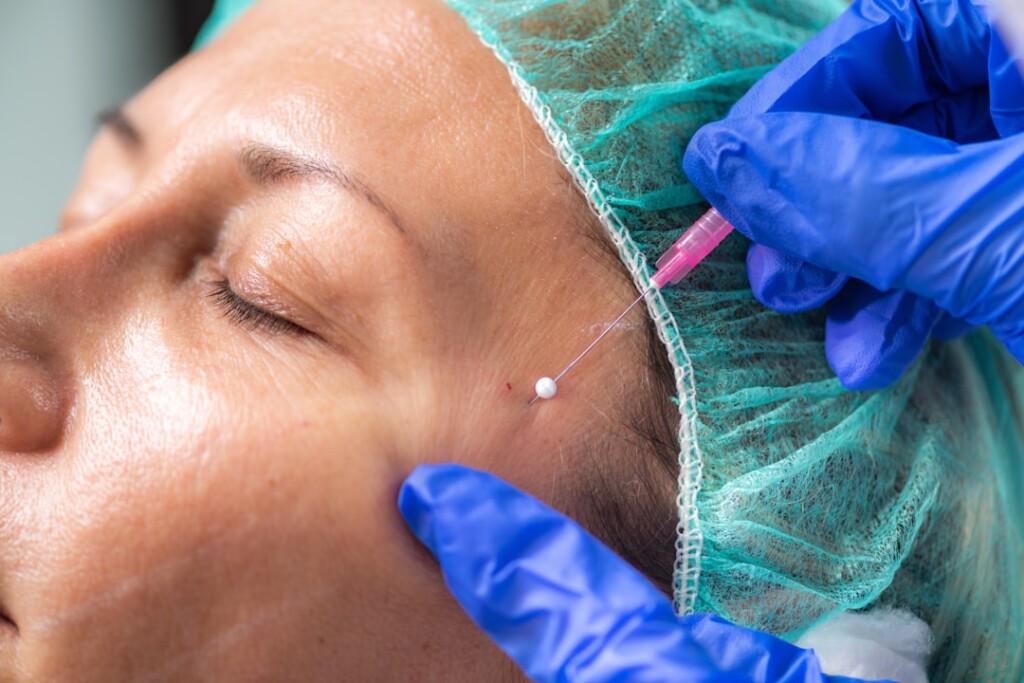
A skin booster session is straightforward and typically takes 30 to 45 minutes including numbing. After cleansing and applying a topical anesthetic, Fahimeh places microinjections approximately 1 centimetre apart across the treatment area, which may include the full face, neck, or decolletage. The needle is fine, usually 30 to 32 gauge, and most patients describe the sensation as mild pinching rather than significant discomfort.
You may notice an immediate glow in the days following the first session, driven largely by the deposited hyaluronic acid binding water in the dermis. This is real hydration at the tissue level, not a surface effect. The deeper improvements, smoother texture, better moisture retention, and subtle softening of fine lines, develop cumulatively across sessions as fibroblasts respond to the nutrient supply and the microinjection stimulus. Results are not instant in the way a filler result is. They build over weeks.
An initial course typically consists of 3 to 5 sessions spaced 2 to 4 weeks apart. By the second or third session, most patients describe their skin as more hydrated and luminous in a way that looks like rest rather than treatment. After the initial course, maintenance sessions every 3 to 6 months sustain the dermal environment. Downtime is minimal. Some patients experience mild redness or small bumps at injection sites that resolve within hours to a day.
The most common reason patients abandon a skin booster course is not treatment failure but discouragement from expecting results on the wrong timeline. Skin responds to biological processes measured in weeks, not days. Patience is part of the protocol, and understanding that before you begin prevents the frustration of judging day-one results against a timeline that belongs to session three. For more detail on how treatment timelines vary by product and area, our guide on how long fillers last breaks down what to expect across different injectable categories.
Frequently Asked Questions
Is a Skin Booster the Right Next Step?
Deciding whether skin boosters belong in your treatment plan is a question that depends entirely on what is happening beneath the surface of your skin. If the primary concern is hydration, texture, and radiance, and your facial structure still has adequate volume and support, a skin booster addresses that biology directly and effectively. If the concern is hollowing, deflation, or folds that reflect deeper structural loss, a skin booster is not the right tool, and saying so is part of honest practice.
Your first consultation should feel more like a diagnostic conversation than a sales appointment. Fahimeh will examine your skin, discuss what you have noticed changing, and determine whether skin quality is the primary issue or whether deeper structural support needs to come first. You may leave with a treatment plan, or with the honest answer that this is not the right step for you yet. Either way, you will leave with clarity.
Book a consultation with Fahimeh at FAH Signature Clinique to explore whether skin boosters are the right next step for your goals. You may leave with a personalized plan, or with the honest answer that a different approach would serve you better. Either outcome is a valid clinical decision, and either one is a step toward skin that looks like you, only more rested and more luminous. If you would like to understand how skin boosters compare to other skin quality treatments like mesotherapy and PRP, our guide to mesotherapy for face explains the distinctions in detail.
Frequently Asked Questions
Do skin boosters add volume to the face?
No. Skin boosters use non-crosslinked hyaluronic acid that disperses into the dermis to improve hydration and texture. They do not add volume or contour the way traditional dermal fillers do. If your concern is volume loss or hollowing, a structural filler or biostimulator would be more appropriate.
How many skin booster sessions do I need to see results?
An initial course typically consists of 3 to 5 sessions spaced 2 to 4 weeks apart. You may notice a glow after the first session from the hyaluronic acid deposition, but deeper improvements in texture and hydration build cumulatively across the course. Maintenance sessions every 3 to 6 months sustain results.
Are skin boosters the same as mesotherapy?
They are related but not identical. Skin boosters typically deliver hyaluronic acid alone into the dermis, while mesotherapy delivers a multi-ingredient cocktail that includes HA alongside vitamins, amino acids, peptides, and antioxidants. If your concern is isolated dehydration, a skin booster may suffice. Broader concerns like dullness and uneven tone may benefit from the mesotherapy approach.
Will skin boosters help with deep wrinkles or folds?
No. Skin boosters improve skin quality at the surface and superficial dermal level. Deep folds or structural changes like nasolabial folds or midface deflation require volumetric treatment with a traditional filler or biostimulator. A consultation can determine whether your concern is skin quality, structural support, or a combination of both.
Is there downtime after a skin booster treatment?
Downtime is minimal. Some patients experience mild redness or small bumps at injection sites that resolve within hours to a day. Most people return to normal activities the following day. The treatment uses very fine needles and a topical numbing cream, and most patients describe the sensation as mild pinching.